Saturday, 3 August 2019

Dementia: Melancholic & Phlegmatic

Previously:

We looked at Resolve, the Delirium & Dementia table, Choleric Dementia, and Katochic Dementia.

Now:

Melancholic Dementia

Melancholic dementia is associated with black bile (whatever that is), the supposed cause of sadness and depression in the outdated and discredited Four Humours system of the ancient world.

Roll 1d6.
  1. Alienation: The afflicted loses their sense of society.
    The Dementia score is expressed as a penalty to the benefits of Carousing and other social activities.
  2. Black Blooded: The blood of the afflicted feels heavy and sluggish in their veins, weighed down with bile. With it comes a sadness of the heart and a sense that the world weighs down upon them like a mountain upon their shoulders.
    Resolve and stamina costs to boost rolls are doubled (2 points per +1).
  3. Delver's Dishonour: The afflicted are able to mostly function normally (half normal penalty from Dementia for actions). However if reminded of their trauma (drop below half Resolve, lose more than 10-score Resolve at any one time, fail a save versus Madness, take damage to Spirit, or at the GM’s whim) they immediately experience their full score as an attack of Delirium lasting for 2d6 rounds (2d6x6 seconds).
  4. Hounded: The afflicted feel dehumanised, bestial and wild. They instead identify with an animal, most frequently a canid. They will find some charm, item, or clothing that they associate with their animal and will keep it with them at all times. If seperated from it then they take alf the dementia score as a penalty to all actions until they are reunited with it, or a similar item. Furthermore, on nights when the full moon is visible they will behave as if transformed into that animal, although no transformation will take place.
  5. Isolationist: The afflicted finds it hard to carry out normal day to day tasks, especially interacting with others. It’s not that they lack the desire for a social life only that they struggle to leave their place of residence.
    They have a limited number of places that they feel safe in. Roll a resolve die for the character, with no modifiers, and the total is their number of safe places. Outside of these places the character suffers a constant penalty to all actions equal to half the dementia score.
  6. Soldier's Heart: The afflicted becomes breathless easily and lacks energy.
    Divide the maximum Stamina (hit) points of the afflicted by the Dementia score and round to the nearest whole number. The total is their maximum Stamina (hit points) until they recover from the dementia.

Phlegmatic Dementia

Phlegmatic dementia are associated with phlegm; you know, snot. This was once believed to cause apathy and disinterest. 

Roll 1d6.
  1. A Route To Understanding: The afflicted believe that they have had an epiphany, that they have come to a new understanding about their world and reality as well as their place in it. They might be wrong, they could be right, but in neither case can they be convinced of any conflicting worldview.
    Their Dementia score acts as a bonus to resist alternate worldviews, actually adding to saving throws. Saves still cost resolve.
  2. Crisis of Faith: The afflicted feels abandoned by the divine.
    [Wyrd] costs for all channelling/divine magic is increased by the Dementia score. Which is to say a 1st level spell would be cast like a 3rd, 5th, 7th or 9th level spell.
    Further the Dementia score adds to any saves against channelled spells. Such saves are automatic and without resolve cost. Instead it costs resolve to NOT save against them.
  3. Doom Touched: The afflicted senses that their personal end is at hand and act to bring it upon themselves.
    It costs a point of resolve to use stamina to soak physical damage. Otherwise all damage goes straight through to vitality.
    Additionally the dementia score is applied as a penalty to all saving throws.
  4. Feeble Minded: The afflicted finds their thoughts sluggish and ungainly. Their memories fragmented and riddled with holes.
    The Intelligence and Wisdom attributes of the afflicted are reduced by half the Dementia score until they recover. This does not affect Spirit. But it does everything else related to those scores.
  5. Nervous Poverty: The afflicted is constantly on edge and emotionally fragile.
    The maximum Resolve points of the afflicted are divided by the Dementia score. The total becomes their maximum Resolve score until they recover from the dementia.
  6. Pacifist: The afflicted has seen too much violence and has lost the will to visit it upon even the deserving.
    Their Dementia score acts as a penalty towards any attack or damage the afflicted makes.
That's it for today. But join me next time for what should be last post in the series when we confront phobia and sanguine dementia.

Friday, 2 August 2019

Dementia: Katochic

Previously we looked at the Resolve mechanic, the Delirium & Dementia table and the Choleric dementia.

Now we're going to look at:

Katochic Dementia:

As I said before Katochic comes from the (ancient) Greek words Kato ("Underworld") and Chic ("In the fashion of..."). Thus it means "In the fashion of the underworld". It is thus synonymous with possession and outside influences. Katochic dementia thus appear to be forms of possession, external influences, or interactions with supernatural forces, raising the question whether a character is truly suffering from dementia at all.

Please keep in mind that these tables are still works in progress. I intend to give every entry a system based effect but they're not all there (b-dum-tish) yet. That's also not something everyone finds desirable. But as always YMMV.

Roll 1d6:

  1. Haunted: The afflicted sees dead people. Sometimes even when they aren't there.
  2. Infestation: The afflicted believes that they have become infested with parasites; fleas, worms, bugs; what-have-yous.
  3. Minsc's Companion: The afflicted believes that one of their items, or in some cases a pet, is not only animate but intelligent and communicating with them.
  4. Shadow Touched: The afflicted hear voices whispering dark secrets to them, criticisms of their actions and appeals to harm those around them. It is almost as if the evil of the last dungeon has seeped into their minds. 
    The Dementia score manifests as a penalty when they’re trying to concentrate on tasks, spell casting and saving throws as the voices seem to seek to distract and dismay the afflicted. However if the afflicted heeds the voices and follows their advice they may instead gain their score as a bonus to research rolls. However the result of such advice are always tainted by evil and, while possibly accurate, easily misconstrued.
  5. Stark Hunger: The afflicted feels possessed by a malevolent spirit that gives them an unnatural hunger. They feel the urge to sate this insatiable hunger at any opportunity, prioritising it above other deeds. This is often distressing for the afflicted 
    At the start of every session the character rolls a save versus Madness against (10+Dementia score). If they succeed they resist the hunger. Otherwise the hunger becomes overpowering and the afflicted is drawn to act upon it. This urge does not abate until the hunger is sated. During this time half the Dementia score is a penalty to any action that is not towards appeasing the hunger. 
    If, by the end of the session, the hunger is not sated then the full Dementia score becomes a penalty to all downtime activities that don’t sate the hunger, until the hunger is sated. They will sate the hunger before the next session in which they play. How that plays out is between the player and GM. 
    If the hunger is sated in play the afflicted feels an overwhelming sense of completion, tempered in many cases by guilt. The afflicted gets a bonus to all activities for the rest of the session equal to half the Dementia score.
  6. Rider: The afflicted manifest an alternative persona that shares the body of afflicted but can be of a different class or even race. Sometimes these personas claim to be extensions of the afflicted, friends or relatives, sometimes the spirits of the deceased. Or even supernatural entities. Sometimes they express themselves at seemingly logical times, while at other times seemingly at random. The rider has full control of the body of the afflicted when they are manifest but have their own Intelligence, Wisdom and Charisma scores. As well as stamina, resolve, spirit and experience level. They begin play with a character level equal to their host’s minus the Dementia score, with a minimum of first level, and level up separately from their host. However because they share a body all wounds are shared. From the point of view of the rider it may be they who are being ridden. 
    If an active persona wishes to manifest an inactive persona then the inactive persona must succeed in a save versus Madness, with a penalty equal to the Dementia score, to resist. Otherwise they manifest against their will. Or they could just choose to manifest. 
    If an inactive persona wishes to manifest against the will of the active persona then it is the active persona that must make the save versus madness (with the same penalty) to resist them. 
    Inactive personas are considered to be resting when it comes to healing and spell memorisation.

Types of Stark Hunger:

Roll 1d6.
  1. Avarice: The afflicted hungers for gold and material wealth. They will sometimes go so far as to steal from their allies.
  2. Cannibalism: The afflicted hungers for the flesh and blood of their own kind. This includes all intelligent beings. They will feast on the fallen as well as kill to get their taste of flesh.
  3. Inebriation: The afflicted hungers for intoxicants, seeking to lose themselves in drink and drugs.
  4. Lust: The afflicted hungers for their own sexual release. They often have no concern for the desires or pleasure of their partners. This isn’t just lust for lust’s sake but lust regardless of the consequences. It’s not tied to their sexual preferences or ideals, or orientation. It’s a compulsion. No redlight district can be passed without sampling. No “interesting” monsters or beasts can go unmolested. They will seduce rather than fight. Fuck rather than negotiate. They need not even enjoy themself. They just wanna. 
    (Please consider the comfort of the other players and GM when roleplaying scenes involving this dementia.)
  5. Murder: The afflicted hungers to take the lives of other intelligent beings. This is not the death of any intelligent being, slaying one's enemies in self defence is not murder. 
    The afflicted will often ritualise their slayings to mark them as special or different. At the same time they’re not stupid and will attempt to cover their involvement in any ‘extracurricular’ killings if it will cause them trouble.
  6. Perversion: The afflicted hungers for deviant activities and company. This is not “all of the above”. The afflicted does not seek wealth for its own sake but would find certain object-de-arte appealing. They don’t seek to consume the flesh of others but if presented with a juicy  “long pig” chop they would find it hard to resist. They don’t seek to drink themselves into oblivion but sample exotic narcotics and rare, perhaps unwholesome, liquor. They don’t seek sexual company to gratify themselves but wrap it in taboo, risk, or ritual and aberration, and they will feel the need to participate. They don’t desire to end the lives of others but bind a maiden to an altar of a dark god and hand them the knife. See the desire fill their eyes. 
    The afflicted will seek out the companionship of people with compatible tastes, feeling the desire to join secretive cults and clubs of like minded people where they can sate their perverse hungers.

Types of Rider.

Roll 1d3:
  1. Avid Rider: The avid rider acts in their own best interest and has a [neutral/selfish] alignment. This does not mean that they are unsympathetic to their host and their colleagues; the rider may just believe that they have a better grasp of what those interests are. The rider will only try and take over their host’s body if it suits their interests or if they think that the persona currently in control is putting them at some risk.
  2. Kind Rider: The kind rider acts in the best interest of their host and their comrades, having a [good] alignment. The kind rider won’t, as a rule, attempt to take control unless the persona currently in control is acting in a manner contrary to the rider’s alignment. Or unless the active persona is incapacitated by Delirium or something similar.
  3. Vile Rider: The vile rider actively acts against the best interests of their host and their comrades, having an [evil] alignment. This doesn’t have to mean that they’re self destructive; indeed they may seek a way of permanently usurping control of their host body. The vile rider will attempt to take control at any opportunity. Provoking the active persona to make saves versus Madness to lower their Resolve at the most inopportune times and make it easier for the vile rider to assume control.
Next time we'll go through melancholic and phlegmatic dementia.

Thursday, 1 August 2019

Dementia: Choleric

Previously:

There are six expressions of dementia. Choleric, which expresses itself as violence and aggression; Katochic, which expresses itself as multiple personalities, prophetic pronouncements and similar; Melancholic, which expresses itself as depression and anxiety; Phlegmatic, which expresses itself as apathy and catatonia; Phobic, which expresses itself as irrational fear; and Sanguine which expresses itself as mania and delusion.

And Now:

Firstly I'm going to apologise for going back to numbered bullet points instead of proper tables but Blogger can't handle HTML tables with the information density I'm creating. They're not huge but they break something deep in the code and create unreadable word salad.

Rolling 1d6 below to generate what sort of dementia a character is afflicted by:
  1. Choleric
  2. Katochic
  3. Melancholic
  4. Phlegmatic
  5. Phobic
  6. Sanguine
Those of you familiar with the long-discredited theory of Humorism will recognise the temperaments associated with the four humours from Ancient Greece: sanguine (blood), choleric (yellow bile), melancholic (black bile), and phlegmatic (phlegm).
It also has phobic, from the ancient greek for "fear" and katochic. Katochic is a word I may have invented. It comes from the ancient Greek kato; "underneath" or "underworld", and chic; "in the fashion of...". So it means "in the fashion of the underworld" and is synonymous with possession or outside influence.

Today we're going to focus on:

Choleric Dementia

Choleric is synonymous with excesses of aggression and anger. 

Roll 1d6 again.

  1. Berserk Fury: The afflicted becomes maddened to the point of violence.
    Every time they take Vitality, Stamina or Resolve damage they must make a save versus Madness. Failure results in the afflicted flying into a rage and flailing about themselves in their blind wrath. In this state their Dementia score penalises their Defence but is a bonus to their damage and melee attacks.
  2. Talking Shit:  The afflicted experiences hard to control tremors and vocal utterances, usually of an obscene nature, when startled or upset.
    Half the Dementia score is expressed as a constant penalty to Dexterity and stealth. When the afflicted loses Resolve the penalty becomes the full Dementia score for the rest of the following round.
  3. Cruel Streak: The afflicted become aggressive towards their allies, believing them to be weak and the cause of all the woes the afflicted suffers. They develop a tendency to lash out at those around them. They take their Dementia score as a penalty in Charisma when it comes to interacting with NPCs. They essentially gain the Barbed Wit talent but without the self control. The afflicted gains the same amount of Resolve points themselves as their victims lose.
  4. Martial Zeal: The afflicted are filled with wrath seemingly of a divine origin.
    The puissance of their blows and their aim against their foes are heightened but against their friends and allies, even those that have turned against them, are weakened. Unlike berserk fury this is a constant effect. Add half dementia score to combat rolls against enemies but subtract it against (former) allies and friends.
  5. Ratted: The afflicted cease to trust their colleagues and others, believing that they are all out to harm and/or deceive them.
    The Dementia score manifests as a bonus to all saving throws, except Madness. It also penalises the character’s Charisma when it comes to interactions with others including loyal henchmen and hirelings.
  6. Waking Dreams: The afflicted struggles to sleep and finds that their waking hours take on a surreal and dreamlike character as they are plagued with hallucinations. There is a constant penalty to Intelligence and Wisdom equal to the Dementia score as well as a penalty to all activities equal to half the Dementia score.
Next time we'll look at the Katochic dementia.

Wednesday, 31 July 2019

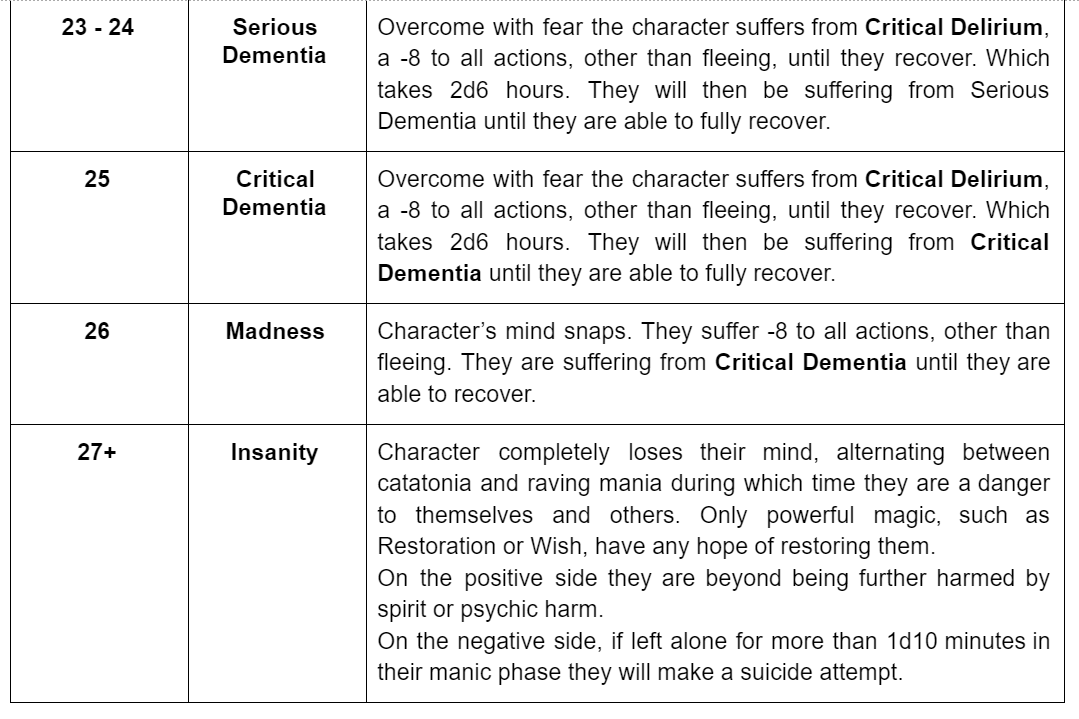
Delirium & Dementia

Previously:

I wrote about Resolve and Spirit.

Delirium & Dementia.

The Delirium and Dementia table is to mental health and stress what the Death and Dismemberment table is to physical health and injury.

When a character dips (momentarily) below zero Resolve or starts taking damage to their Spirit then roll 3d6 and add the number of points that the character would have gone into negative Resolve or the amount of Spirit damage taken. Depending on how you’re doing things. Compare the result to the table below.


Delirium is a temporary effect, typically an overwhelming fear, that hinders a character’s actions until they recover. However recovery is not without risk. Once the Delirium expires the affected character Saves versus Madness. If they succeed then they gain a point of Resolve instead of losing one. If they fail then they don’t lose any more Resolve but their Delirium becomes Dementia of a similar class (Light Delirium becomes Light Dementia, &etc).

Dementia is a longer lasting effect of a varied nature. There are six expressions of dementia. Choleric, which expresses itself as violence and aggression; Katochic, which expresses itself as multiple personalities, prophetic pronouncements and similar; Melancholic, which expresses itself as depression and anxiety; Phlegmatic, which expresses itself as apathy and catatonia; Phobic, which expresses itself as irrational fear; and Sanguine which expresses itself as mania and delusion.
There are four grades, or degrees, of Dementia, each of which has their own dementia score. Each affliction of Dementia should be recorded separately. 

Next post in this series should start detailing the different types of dementia. 

Tuesday, 30 July 2019

Resolve (and Spirit)

This is the first post in a series on the stress subsystems of what I'm still calling Project Tarragon Oubliette.
This post details the Resolve and Spirit pools, what they are (miiiind hit points!), what they do (stuff!) and how to use them.
The next post should have the Delirium and Dementia table.
That should be followed by the dementia tables in a series of posts due the graphical capacities of my laptop being weak sauce.

Resolve

Resolve is a measure of a character’s mental and emotional fortitude. It is a pool of points that are depleted when a character is subject to stress or converts their resolve into wyrd or psi to fuel certain abilities, such as spell casting and psychic powers.
Resolve is calculated by rolling a number of dice equal to a character’s level. This is usually done by adding a single dice roll to the pre-existing resolve pool when a character levels up. But some players, and GMs like to re-roll the entire pool every level, or in the case of some games, more often.
The number of sides the dice has is defined by their Wisdom score, limited by their origin, and further modified by their class.
Thus a character who rolls a d6 for resolve and gains +1 from their class would roll 1d6+1 per level.
Some GMs permit a starting character maximum resolve at first level. In the example above, such a character would have 7 resolve.

Resolve is typically used to activate and boost dice rolls, specifically saving throws, but can be used to increase other dice rolls at the discretion of the GM. It is also be converted into “magic points” to activate/power any unusual abilities.


  • Saving Throws: Every time a character has to make a saving throw they lose one resolve. Irrespective what the save is against. This is to simulate how general danger and struggle can wear at someone.
    • They can increase their roll by spending a point of resolve per +1 to the roll. This can be done after the roll has been made and represents the mental effort to overcome whatever effect the save was against. This is in addition to the resolve cost above.
      • Typically resolve can only boost saves against effects that influence the mental, spiritual or psychological aspects of a character. In [Tarragon Oubliette] this means saves versus Madness, Mystery, or Misfortune. In other games it would be Intelligence, Wisdom and Charisma saves. Or whatever seems appropriate; Adding it to saves versus Breath Weapon would be weird, but not necessarily so against Paralysis.
      • Some GMs may insist that a character with sufficient resolve to boost a saving throw up to a success do so. This is perfectly fine in a horror setting. However I feel that should be the choice of the player, in other settings, with the repercussions of a failed saving throw being enough in themselves.. 
  • Boost Rolls: A point of resolve can be used to increase any one dice roll (GM’s discretion) by +1. As above.
  • “Magic Points”: Called Wyrd or Source in [Tarragon Oubliette], and including Psi if psychic powers are used. One point of resolve can be converted into one point of another at a rate of 1 per second/segment (adjust to your system).
    • Wyrd/Source (they’re essentially different names for the same thing; could also be called “essence”, “mana” or anything else similar) is spent to activate/fuel supernatural abilities. It can also be used to cast memorised spells. Instead of forgetting a spell when it is cast a number of points of wyrd equal to the level of the spell are spent to retain the spell. However many, if not most, characters lack inherent wyrd (naturally having zero wyrd)or have actual “wyrd debts” (negative wyrd) that must be overcome. This is where resolve comes in. Characters without wyrd based abilities/spellcasting can’t access or use them. Spent wyrd points are lost and a character’s wyrd reserves reset to their natural levels at the beginning of the game day.
    • Psi points are used to activate psychic/mystic abilities and powers. This whole thing is optional and still a work in progress. 

Resolve is also lost due to injury; when a character is injured they lose an amount of resolve equal to the wound penalty, which is related to the degree of injury. This resolve cannot be recovered until the injury is healed.
Resolve can also be lost as damage due Psychic or Spiritual attacks. Or rather and resolve loss caused from outside a character (such as the point lost from rolling a saving throw or from some other source) is classified as psychic or spiritual damage.
As an example: A spell that causes fear would, instead of just causing a fear effect, roll a number of dice the total of which would be applied as psychic/spiritual damage. Characters afflicted by the spell would lose resolve up to that amount, in much the same way they’d lose stamina/hit points from other attacks.
Resolve never drops below zero. If it would go below zero for any reason then the excess is applied as damage to Spirit (see below)and/or is added to a roll on the Delirium and Dementia table.

Spirit (Optional).

Spirit gives an upper limit to the amount of psychic and spiritual damage a character can take. Without it a character can just keep taking damage to their resolve, make low rolls on the Delirium and Dementia table below and keep on going endlessly. From certain perspectives this can be seen as a good simulation of mental health; it is certainly hard in reality to judge when someone will break mentally or emotionally. However from a gameplay perspective this removes player agency as they can’t judge their breaking point accurately.
Spirit equals the totals of character’s Intelligence and Wisdom attribute scores. Additionally, if you don’t want a static spirit score, add the resolve bonus from class per level.
Spirit has all the same functions as resolve but can’t be used to boost rolls or be converted into magic points. Instead all spiritual or psychic damage depletes spirit.
When Spirit reaches zero a character’s soul dissolves into a number of fragments equal to their maximum Spirit score and are lost, dead forever, unless the character is bound to a Spirit Womb, Familiar, Soul-Cist or similar. Their body, if it still retains Vitality, is an empty catatonic husk ripe to be taken over by any passing disembodied spirits.

Recovering Resolve and Spirit.

Resolve is recovered at 1 point per 10 minutes rest. However Stamina cannot be regained at the same time. Furthermore:

  • It can also be restored to full after a good night’s sleep (of roughly 6 to 8 hours, which don’t need to be consecutive) in a comfortable bed, or after a night sleeping rough following a day without stress (a day when no resolve is lost)
  • A night’s rough sleeping, after a day of adventuring; or a night spent carousing will restore half a character’s resolve.
  • Every time a player rolls a maxed die their character regains 1 point of resolve or spirit.
  • Whenever a character defeats a foe in battle they regain a number of points of resolve equal to that foe’s level or Hit Dice.

Spirit is recovered at one point per hour. This is irrespective of activity.
Just as resolve recovery is capped by penalties from injuries, spirit recovery is capped by penalties from dementia. As long as they are suffering from dementia a character cannot recover their full spirit.

  • For example, if a character with a maximum of 21 Spirit is suffering from dementia with a total score of 6, their Spirit would be capped at 15 until they recover.

This ‘spiritual weakness’ could, in some settings, open the character up to possession and other afflictions similar to katochic and melancholic dementia.

Next post on this topic will be on the Delirium and Dementia table.

Thursday, 25 July 2019

Heads Up

I'm going to take a break from Heroes Unlimited and Phenomenal Paragons for a bit. I've got a whole bunch of character write-up to actually write up and a ideas for versus-battles but I don't have anything ready for this week and want to do some 'serious' world building and game design.

I've been asked to compile my Resolve mechanism, which is just a stress mechanic that forms part of the core of Project Tarragon Oubliette. Other subsystems, magic, psionics, superpowers and a bunch of other stuff plugs into it.

I could get a bunch of posts out of it. Or I could just put it all up on Google docs. Each would be about as easy as the other.

As for world building its fairly clear to be me that Fon Choille and related projects are on hold for now because of the desktop's death. So I need a new project to replace it. Something I actually want to finish. Something I can do on this laptop/tablet.

I'm partly inspired by the Ourbossa campaign I read about on Tumblr. (That's the final post in the series, but it links to the earlier ones; warnings for misogyny and cannibalism.) So that would be a shipwrecked island survival game. But I'd want to include some Westmarches elements.

Something to think about once I've written about Resolve.

Saturday, 20 July 2019

Heroes Unlimited: Phenomenal Paragon: The Gargoyle

The parents of Murielle Devine were members of a now defunct infernalist cult. After their world-ending schemes were stopped by The August, Murielle was left to pick up the pieces of her life. She was driven into hiding from mob debt collectors. In an old cult safehouse she found a demon lord bound and imprisoned. It offered her power in exchange for its freedom and, raging against those that hounded her, she accepted. Now marked and transformed into knight of hell she seeks to turn her dark powers to defend the unjustly persecuted as The Gargoyle.

Related image

This is the thirteenth character in my Phenomenal Paragons series. The introduction to which is here. It is inspired by Jacob Pisson's World's Strongest series, here.

So I shelled out for Armageddon Unlimited book when all the Heroes Unlimited books were on sale earlier this year. It's the Heroes Unlimited sourcebook for the blood war Minion Wars. Which definitely isn't Palladium's version of D&D's Blood War. No. Certainly not. Whatever gave you that idea. Look they're totally different.

The Blood War is an eternal conflict between the Demons of the Abyss and the Devils of the Nine Hells It is an extension of the ancient conflict between Chaos and Order. The fate of the whole multiverse hangs in the balance, but both sides are so equally matched there will probably never be a resolution.

On the other hand the Minion War is a recent conflict between the Demons of Hades and the Deevils (not a typo) of Dyval. Each side seeks to destroy the other. The prize is dominion over the whole Megaverse. The conquest of any one world could tip the balance either way.

See. Totally different. Deevil is spelt with two "e"!

Since Phenomenal Paragons is its own thing, definitely not set in the Megaverse (I'm just using the system for my own amusement), and I'd never be able say the word "deevil" with a straight face, it's of limited use to me. The bits that are useful, the new superpowers and character classes are more than enough what I paid for the book. It also inspires some worldbuilding thoughts.

One of these thoughts is that while there are demons and deevils in this setting they are not as advertised; there are many different "Hells" out there in the multiverse. Some of them are a lot like the versions of Hell as depicted by various popular religions. Indeed there are caverns in the valley of Gehenna, near Jerusalem, that lead to a Hell world that was abandoned around two millennia ago. Indeed until relatively recently it was used by mutants escaping persecution. The natives of these hell worlds are typically powerful supernatural beings with moral and spiritual natures antithetical to the natives of Earth. That said, there are also worlds out there which would classify the Earth of the Phenomenal Paragons to be a hell world.

So. Anyway. The Gargoyle.

The new character classes from Armageddon Unlimited includes a bunch of mystical bestowals, including from demons and devils. Of course no hero would make a pact with an infernal sponsor for power, right? And those two classes are flagged as being only suitable for villains. Except. There's the Corrupted Hero 'class' where a good-aligned character makes a deal for power with a fiendish source out of desperation or by accident.

This is one of two ways of getting a 'good' aligned character with demonic powers. The other is the "Heroic Hellion", which is a redeemed fiend. We'll get one of those some other time.

Since this is not one of those classes that holds hands I'm going to blast through character creation.

Attributes: 11's across the board.

Alignment: 10 - Non-Conformist.

Education: 3 years of college and a trade school. They're an information broker. This gives them: Native Language, Native Literacy Basic Maths, Advanced Maths as default skills.
They get Espionage: Information Broker as their starting program. This has another Literacy, Computer Ops, Computer Programming, Cryptography, Basic Radio, Radio Scramblers, Computer Hacking, Intelligence, Research.
They also get 4 basic programs.
The first of these is Basic: Cultist which is how they encountered  demon in the first place. This gives them Lore: Demons & Monsters with +10% because of their patron, Lore: Magic, Lore: Geomancy & Ley Lines, Lore; Cults & Sects, W.P. Knife.
For the next two  I decide that they are an alumni of the Blyghton Foundation's Summer Scholarship (which I really must finish writing up) This means that the second is Basic: Adventure/Tomb Raiding. This gives them Archaeology, Climbing, Horsemanship, a +10% to Research, and Wilderness Survival.
 The third is Basic: Explorer. This grants a +10% bonus to Climbing, the Dowsing skill, Land Navigation, Mountaineering (+1 PS, +1 PE, +10 SDC, +10% all climbing skills),  Prospecting, Spelunking, Swimming, and a +10% to Wilderness Survival.
The fourth and final basic program is Basic: Professional Athlete. This gives them Athletics (+1 parry/dodge, +1 roll with impact, +1 PS, +3 Spd, +5 SDC), Dieting (+2 HP, +1 PE, +1 PB), Running (+1 PE, +10 Spd, +3 SDC), Acrobatics (2d4 acrobatic kick, +2 roll with impact, +1 PS, +1 PP, +1 PE, +3 SDC), Boxing (+1 attack, +2 parry/dodge, +2 PS, +1 roll with impact, +10 SDC), Wrestling (pin on 18+, 1d4 crush, +1 roll with impact, +2 PS, +1 PE, +14 SDC).
Finally there's 12 secondary skills. The first 3 I spend of Hand-to-Hand Martial Arts, they I choose Pilot Automobile, Pilot Motorcycle, W.P. Archery, First Aid, Lore: Conspiracy, Play Musical Instrument: Guitar, Cooking, Bodybuilding (+2 PS, +10 SDC), and Streetwise.

Reason for Pact: Anger.
They were angry enough at something in the world that making a pact with an infernal entity seemed like a reasonable decision. Although it doesn't say so in the rules I've decided that that anger is inherently tied to their powers. Not in a Hulk-like they get angry and lose control of their powers. No quite the opposite. Whenever they use their powers the experience that original wrath all over again. This means that they're liable to lash out with their powers and, to some school of thought, means that any use of their powers in inherently sinful.

Empowered By: Demon Lord.
Their powers came from a demon. This gives them a Horror factor of 12, +1 save versus possession, +4 save versus Horror, +1 initiative, +1 strike, +1 parry, and +1 dodge. They have +3 MA (with a minimum of 16), +9 PS (with a minimum of 22), +3 PP (with a minimum of 18), +7 Spd, +20 Hit Points and +55 SDC when transformed into their demonic form.
They are vulnerable to holy and silver weapons, which cause double damage, as well as demon slaying weapons. They have an obvious demon mark somewhere on their body (a brand-like scar on their left breast) and the demon that empowered them knows their true name.
They have the rank of Demonic Knight (actually "task master" but that's a bit bleh) which grants them command over sub and lesser demons. At 6th level they are promoted to Demonic General (actually "master" but, y'know) and assigned a cadre of 1d4 lesser and 1 greater demon.

They get 2 demonic abilities. I roll:
Fire Resistance: Half damage from all fire.
Demonic Physique: +3 PS, +1 PP, +1 PE, +30 SDC, +2' height and +100 lbs. weight.

Our Superpower is Brute Strength.
This gives us +20 Hit Points and +30 SDC.
It also gives us Supernatural Strength (+37 PS; carry x300 lbs, lift 500 lbs, fatigue at 1/10th normal rate, +2 pull punch) and two other Major powers associated with physical strength and power.
For my first I pick Mega Wings. This is winged flight, only MEGA.  They grant winged flight at 360 mph with an additional 40 mph per level. They have a maximum altitude of 30,000 ft. They also grant +2 PB, +1 attack, +2 initiative, +2 parry with the wings, +2 dodge in flight below 90 mph and +6 dodge at faster speeds; they get +4 damage for every 20 mph of flight. The wings have AR 16 and 330 SDC each. The wings recover 1d6x10 SDC per hour. when harmed The character can hold their breath for 8 minutes, are unaffected by altitude and can accelerate to top speed with 1 action. They cam form  a wing cocoon around themselves or someone adjacent, granting them an AR of 17. Any attacks made with a wing do +1d6 damage and have a range of 8'.
For the second I consider APS: Stone but that would just negate all the sweet bonus SDC we've been getting. So instead I pick Massive Damage Capacity. This gives an AR 9, which will improve as we level. We also get +70 HP (+10/level) and +300 SDC (+100/level). we regen 1 point of damage every 2 minutes (30 per hour), fatigue at 1/3rd normal, get +2 PE and +10% save versus Coma/Death.

Okay. So let's put this all together.

Name: Murielle Roshanak Devine
Identity: The Gargoyle
Team: The Furies
Level: 1, Mystical Bestowal: Demonic (Corrupted Good)
Height: 6'5" (8'5"), Weight: 275 lbs (375 lbs), Age: 21
Alignment: Non-Conformist
Disposition: Hot headed and angry. Quick tempered and emotional but fundamentally a nice person.
IQ 11, ME 11, MA 11(16), PS 20(69), PP 12(19), PE 16(19), PB 12(14), Spd 24(31)
Hit Points: 21 (134), S.D.C.: 85 (500; 330 wings), P.P.E.: 20

Demonic Attributes:
Demonic Form: Transforms into demonic form to use powers. All attribute scores in parenthesis are for demonic form. Demonic Form has Horror factor of 12.
Vulnerabilities: 2x damage from holy and silver weapons. Vulnerable to demon slaying weapons.
Obvious Demon Mark: Rune-like branding scar on left bosom, over heart. Recognisable as such on a successful roll against Lore: Demons & Monsters. Further demon lord patron knows character's true name.
Demonic Knight: Can command demons of sub and lesser types.
Demonic Physique: Demonic form is 2' taller and 100 lbs heavier.
Fire Resistance: Half damage from  all forms of fire, heat and flame.
Brute Strength. Demonic form's super powers are strength themed.

Superpowers:
Supernatural Strength.
Mega Wings. AR 16/17 wings
Massive Damage Capacity. AR 9 body

Skills:
Natural Skills:
Trust/Intimidate 40% (demonic form only)
Scholastic Skills:
Acrobatics (), Advanced Maths, Archaeology, Athletics, Basic Maths, Basic Radio, Boxing, Climbing (Rappelling), Coding Literacy, Computer Hacking, Computer Ops, Computer Programming, Cryptography, Dieting, Dowsing, English Language, English Literacy, Horsemanship, Intelligence, Land Navigation, Lore: cults & Sects, Lore: Demons & Monsters, Lore; Geomancy & Ley Lines, Lore; Magic, Mountaineering, Prospecting, Radio Scramblers, Research, Running, Spelunking, Swimming, Wilderness Survival, W.P. Knife, Wrestling.
Secondary Skills:
Bodybuilding, Cooking, First Aid, Hand-to-Hand Martial Arts, Lore: Conspiracy, Pilot Automobile, Pilot Motorcycle, Play Musical Instrument: Guitar, Streetwise, W.P. Archery.

Saves:
Coma/Death: +4% (+18%)
Harmful Drugs/Toxins: +1 (+2)
Horror Factor: +4
Magic (Spells 12+, Circles/Wards 13+, Ritual 16+): +1 (+2)
Poison (Lethal 14+, Non-Lethal 16+): +1 (+2)
Psionics (15+): +0
Possession: +1

Combat:
Attacks: 2+3 (+4 demonic form)
Initiative: +2 (+3 demonic form; +5 flying)
Strike: +0 (+3 demonic form)
Damage: +5 (+54 demonic form; +1d6 wing strike)
 1d4+5 Punch
 2d4+5 Acrobatic Kick
 (5d6+54 Restrained Strike)
 (2d4x10+54 Strike)
 (3d6x10+54 Power Strike [2atk])
Dodge: +3 (+6 demonic form; +10 flying below 90 mph; +12 flying faster than 90 mph)
Parry: +3 (+6 demonic form; +8 with wings)
Pull Punch: +4 (+6 demonic form)
Roll with Impact: +8

Benchmarks:
Carry Capacity: 400 lbs. (20,700 lbs.); Lifting: 800 lbs. (34,500 lbs)
Stamina: Carry for 64 minutes. Carry maximum for 32 minutes. Lift for 16 rounds.
     (Carry for 2,280 minutes; 38 hours (1 day and 14 hours). Carry maximum for 1,140 minutes; 19 hours. Lift for 570 rounds; 8,550 seconds; 142.5 minutes (2 hours, 22 minutes and 30 seconds.)
Ground Speed: 16.8 mph for 16 minutes. (21.7 mph for 570 minutes; 9.5 hours).
(Air Speed: 400 mph for 570 minutes; 9.5 hours)
Swimming Speed: 60 yards (180 ft.) per round for 16 minutes. (207 yards (621 ft.) per round for 570 minutes (9.5 hours).)
Leaping Distance: 5 ft. high and 10 ft. broad from a running start. 3 ft. high and 6 ft. broad from a standing start. (276 ft. high and 414 ft. broad from a running start. 165.6 ft. high and 248.4 ft. broad from a standing start.)

Background:
Murielle Devine thought that having parents with secret religions was normal. She spent most of her early years at one boarding school or another. The time she did spend with her parents was usually for some dark ritual or another. She was ten when their final ritual was stopped dead by The August raiding their temple at The Sanctum Hotel. Murielle never saw her parents again. She did not have a happy childhood, her education provided by her missing parents wealth.

The best time she did have was on the four, yes four, summer scholarships with the Blyghton Foundation. She was among the group that found The Wreck of The Content, filled with golden treasure, and entombed in the dunes of Arizona. She found the secret door during The Mystery Of The Thirteenth Attic, helped expose Ridgestar Lab's crimes, and dig out Valentina Graves from a landslide, during The Case Of The Forbidden Spire, and was even able to use the occult lore she'd learned from her parents to resolve the puzzle central to The Secret At Dannity Island. On these adventures she made friends that persist to this day such a the journalist Dahlia Drake.

When she turned 18 everything went to shit. She came into her inheritance and the Strickland mob came looking for money they claimed her parents owed them. After they were done with her all she had left of her fortune was a small former cult safehouse out in the Guardian City suburbs. So of course she found a demon lord bound in the safe room.

It promised her power, it promised her wealth, it promised her vengeance. In return for its freedom. She was angry at the great injustice she'd suffered and more so with having this monster in her home. So she agreed. She'd release it in exchange for a portion of its power. It would never further interfere with her and she in turn would never interfere with it.

Not long after the Blyghton Foundation sent her a check for her share of The Content treasure. Able to afford university after all she studied information technology for three years before deciding to use her talents to become a freelance information broker.

Every now and then she'll uncover some evil deed that has gone unpunished, or someone unjustly persecuted, and she'll let her darker side out to prowl the night.